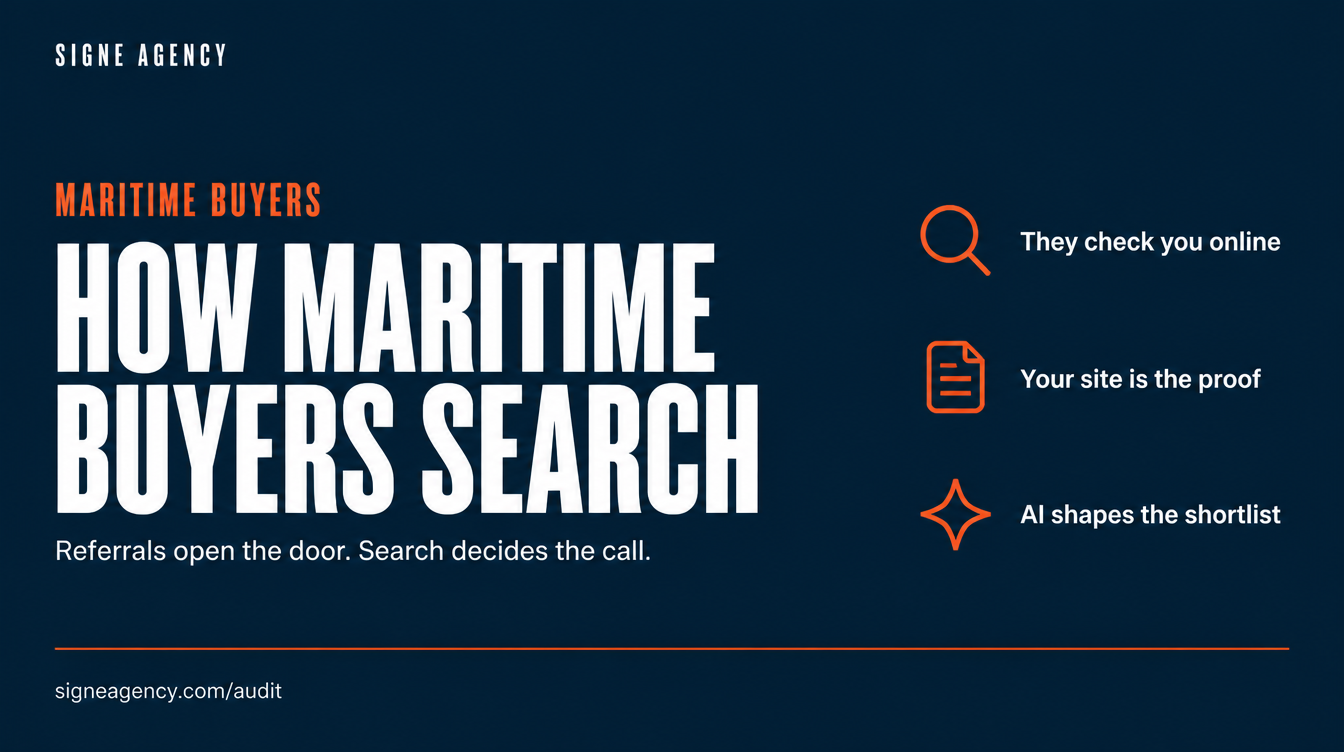
A vessel operator gets a name from a colleague at a conference. Before they call, they search the company. That single search, and the thirty seconds that follow it, now decides more maritime business than any brochure, any trade show booth, or any cold email ever has.
Understanding what happens in that search is the difference between a website that converts referrals and one that quietly loses them. And the search is more specific, more intent-driven, and more revealing of what the buyer actually wants than most maritime companies realise.
What Maritime Buyers Are Actually Searching For
The queries that maritime buyers use are not accidental. A search for marine hull cleaning Rotterdam tells you the vessel is in port, the operator needs a specific service in a specific location, and they are in active supplier evaluation mode. A search for maritime brand agency tells you someone has already decided they need a specific type of help and is now looking for who provides it.
Each query carries intent. The buyer searching for a service by name and location is close to making contact. The buyer searching for a category of service is still researching options. The buyer searching for a company name directly is doing a credibility check, almost certainly triggered by a referral or a mention somewhere else.
Understanding which type of search brought someone to your site tells you what the page needs to do when they arrive. A credibility-check visitor needs proof fast. A category-search visitor needs to understand quickly whether you match their specific situation. A service-plus-location visitor needs confirmation and a direct path to contact.
The Three Stages Before a Buyer Contacts You
Most maritime B2B purchase decisions involve multiple searches across multiple sessions, often over days rather than hours. The buyer journey moves through three distinct stages, and what buyers are looking for in each stage is different.
The first stage is awareness. The buyer understands they have a problem but is not yet looking for a specific supplier. Their searches are broad: why is my maritime website not getting enquiries, maritime digital marketing, how do maritime companies attract new clients. They are not ready to contact anyone. They are building understanding. A maritime company that publishes content at this stage will be in the buyer’s mind when they move to the next.
The second stage is category research. The buyer now knows what type of help they need and is evaluating what that category looks like. Their searches shift: maritime brand strategy, maritime branding agency, maritime website design. They want to understand the landscape before picking a supplier. Content that explains what good looks like, and that demonstrates genuine industry knowledge, performs well here.
The third stage is supplier evaluation. The buyer has decided on the category and is now assessing specific options. This is where the company name search happens, and where the referral converts into a contact. At this stage the website is not marketing. It is a credibility test. Everything on it either confirms this is the right choice or gives the buyer a reason to hesitate.
The Buyer Journey Has a New First Step
The old model was linear: referral, phone call, meeting, quote. The new model inserts a step between referral and phone call: an online check. It is rarely a broad search like marine services near me. It is a narrow, specific query: the company name, or the company name plus the service the buyer actually needs.
Hull Cleaning & Inspection Services | Rotterdam Dry Dock Co.
rotterdam-drydock.com
Specialising in underwater hull cleaning for bulk carriers and tankers. Rotterdam-based, 24/7 availability. Typical turnaround: 6–8 hours.
Marine Services · Global Marine Group
globalmarinegroup.com
We offer a wide range of marine services for clients worldwide.
About Us · Maritime Solutions Ltd
maritimesolutionsltd.com
Learn more about our company and our commitment to excellence.
The Thirty-Second Test
Once the buyer clicks through, the clock starts. A buyer who has other options, and in maritime services they almost always do, gives a new website a very short window to prove it understands their situation. If the homepage does not confirm the vessel type, the geography, or the scope within that window, most buyers leave and do not come back.
Drop-off point
This is where most maritime companies lose the buyer. The loss is silent: no failed call, no lost tender, just a closed browser tab.
What Buyers Are Actually Looking For When They Land
Three things, roughly in this order. First, confirmation that you serve their vessel type or their specific situation. Second, some sense of scale and credibility: certifications, named clients, years operating a specific service. Third, a way to make direct contact without hunting for it. A generic contact form buried three clicks deep costs you buyers who were ready to reach out.
None of these require a redesign. They require the homepage to say, plainly and near the top, who it serves and what it does for them.
The buyers who arrive from a referral need to feel confirmed. The buyers who arrive from a category search need to feel understood. The buyers who arrive from a direct name search need to feel reassured. The homepage cannot be all three things equally, but it can answer the core question that all three types share: is this the right company for my specific situation?
The answer to that question should be visible in the first scroll. Not buried in an About page. Not implied by a list of services. Stated clearly, with enough specificity to land with the buyer who needs you and to release the buyer who does not.
How Your Content Supports Buyers at Every Stage
A maritime company whose only published content is a services page and a contact form is only visible to buyers who are already at the supplier evaluation stage. That is the smallest part of the buyer journey and the most competitive, because every competitor is also there.
A maritime company that publishes at all three stages captures buyers much earlier. At the awareness stage, educational posts that explain common problems: why maritime websites lose buyers, what AI visibility means for maritime companies, how buyers actually search for suppliers. At the category research stage, comparative and specific posts: what maritime brand strategy involves, how to tell whether your homepage is working, what a high-scoring maritime website looks like. At the supplier evaluation stage, proof: case studies, audit results, specific before-and-after examples.
The search engine sees a website with depth and consistency across a topic. The buyer sees a business that clearly understands the problem they came to solve. Both responses compound over time. A maritime company publishing two well-targeted posts per month will, at the six-month mark, be appearing in searches it could not rank for when it started.
Free Worksheet
Maritime Client Focus Worksheet
For owners serving two to four plausible customer types who need to pick one primary focus and stand behind it.
- Your current shortlist
- Decision criteria
- Customer-by-customer comparison
- Evidence check
- Strategic trade-offs
- Primary focus decision
- Next positioning move
Free download. Fillable PDF with a built-in AI prompt. No upsell inside it.
Is Your Website Ready for Today’s Maritime Buyer?
A short honest audit answers this faster than any workshop. Run through your own homepage against these items and be specific about which ones genuinely pass.
Website Readiness Audit
Signe Agency · Maritime Marketing
Homepage names exactly who you serve
No “quality and reliability” filler language
Service pages name specific vessel types
FAQ section answers real buyer questions
Contact page has a direct email or phone
Mobile site loads under 3 seconds
Title tags describe your service, not your company name
A non-maritime person understands your offer in 10 seconds
