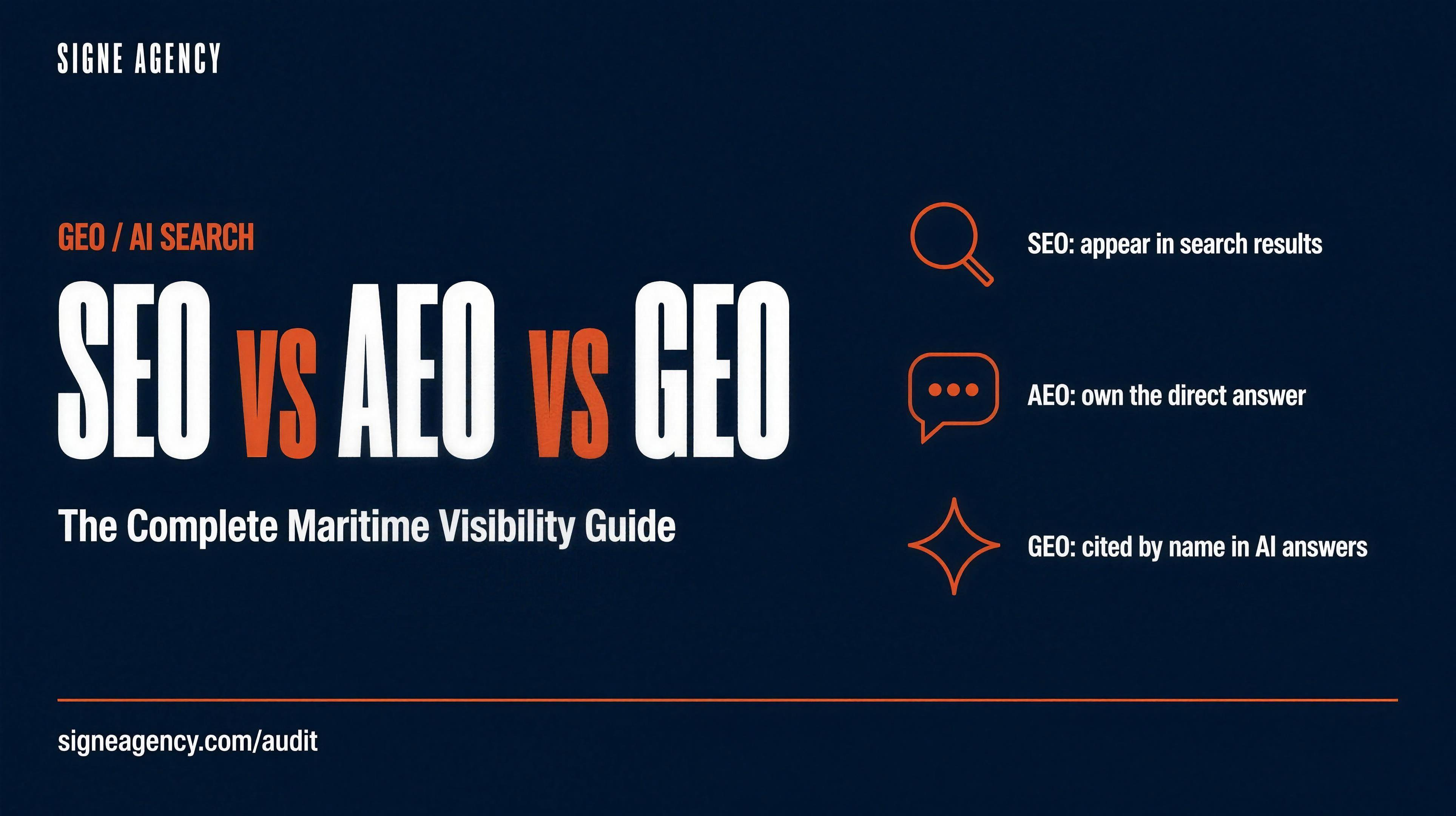
Search now runs on three engines at once. A maritime buyer looking for a ship management firm, a marine surveyor, or a naval architect can type a query into Google, ask a voice assistant for a direct answer, or ask ChatGPT to recommend a provider by name. Each path is powered by a different discipline: SEO for search rankings, AEO for answer boxes, and GEO for AI recommendations. This guide covers all three in full, and shows how a maritime company or a maritime executive builds one strategy that wins across every engine.
Search Became Multi-Engine
For twenty years, being found meant ranking on Google. One engine, one results page, one discipline. That era is closing.
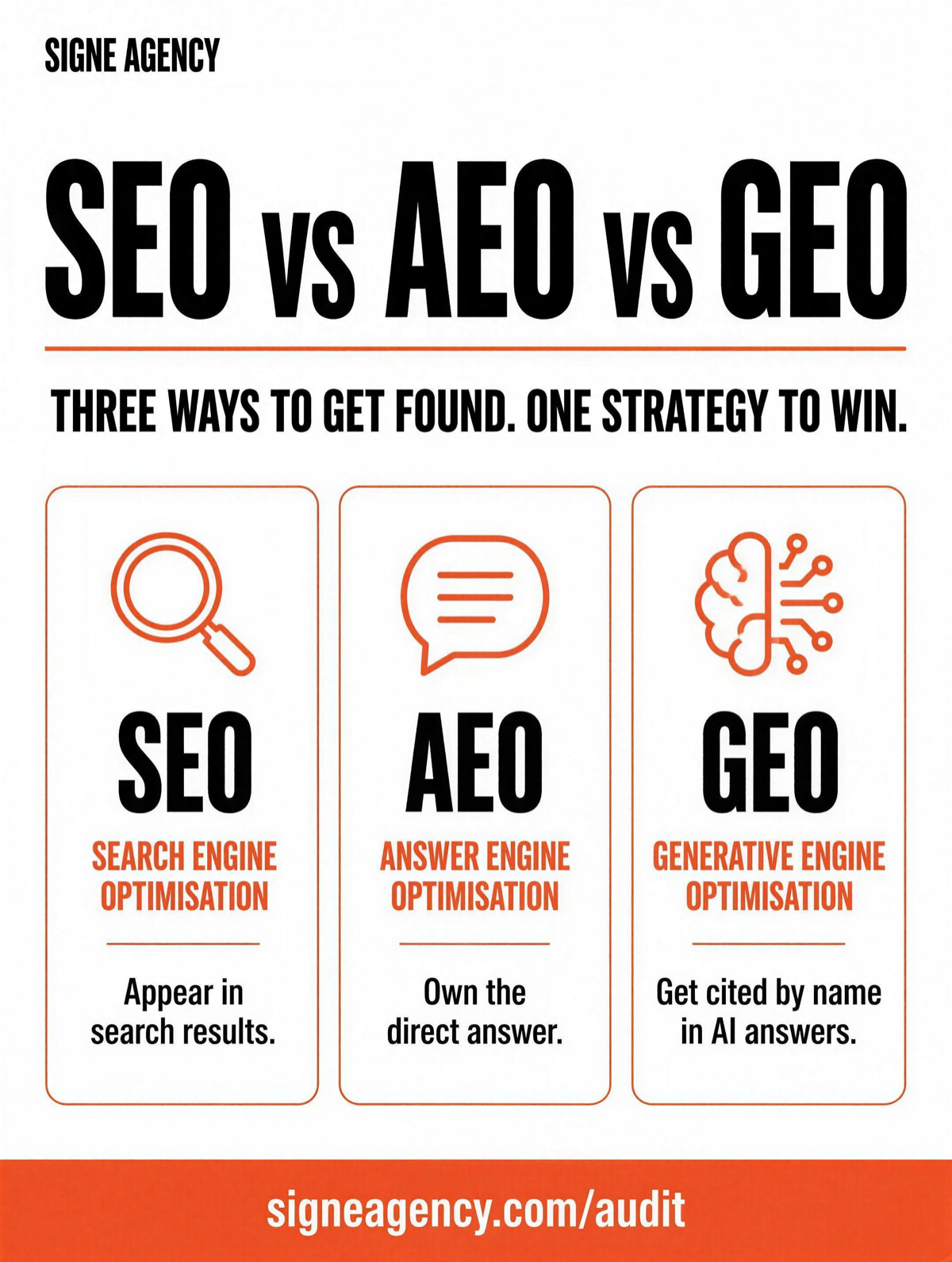
Today a single research question travels three routes. The buyer who searches “ship management company Singapore” sees classic blue links (SEO territory). The buyer who asks a phone “what does a ship manager do” hears one spoken answer pulled from a featured snippet (AEO territory). The buyer who asks ChatGPT “which ship management firms handle LNG carriers in Southeast Asia” reads a short list of named companies with reasoning (GEO territory). Three engines, three disciplines, one buyer.
SEO gets your business into the results. AEO gets your answer read aloud or shown at the top. GEO gets your name recommended inside an AI conversation. Winning today means being present in all three places at the moment a maritime buyer is deciding.
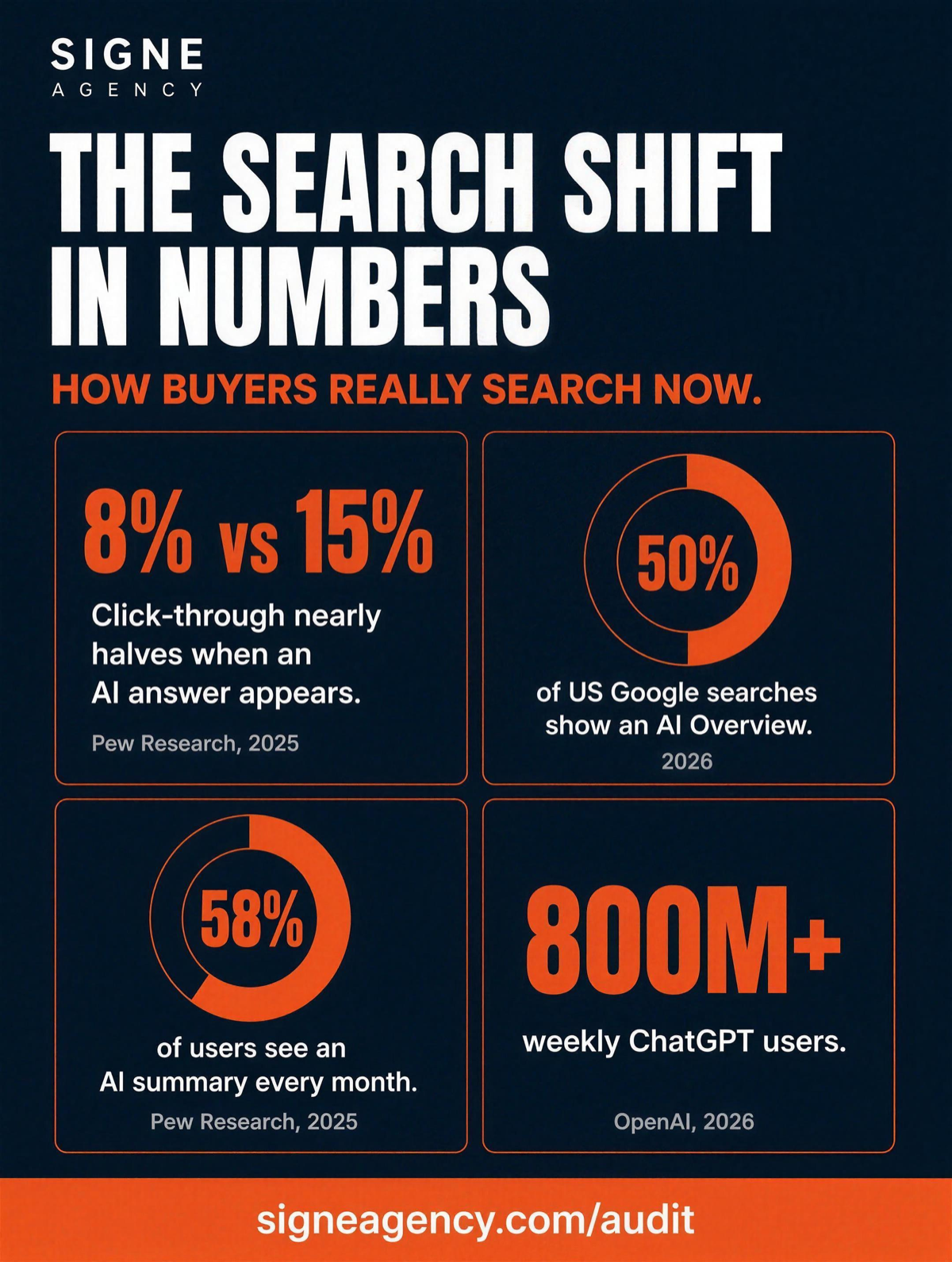
The shift is measurable. When Google shows an AI summary, users click a link 8 percent of the time, against 15 percent when only standard results appear, a near halving of click-through (Pew Research, 2025). AI Overviews now show on roughly half of US Google searches, up from about 6 percent at the start of 2025. In a given month, 58 percent of Google users see an AI summary (Pew Research, 2025), and ChatGPT serves more than 800 million weekly users (OpenAI, 2026). Buyers reach answers through more than one engine, so a maritime brand earns its place on each.
The rest of this guide takes each discipline in turn, using the same structure for all three: what it is, how it works, what it does well, where it falls short, and how a maritime brand ranks higher. After that, the guide covers the company-versus-executive split, the combined strategy, measurement, and the mistakes that keep maritime firms invisible.
SEO: Search Engine Optimisation
What it is
SEO is the practice of earning visibility in the standard search results, the ranked list of links a search engine returns for a query. When a fleet operator searches “marine lubricants supplier Rotterdam” and scans the first page, SEO decides whether your company appears there.
How it works
Search engines crawl the web, index pages, and rank them against a query using hundreds of signals. Three families of signal carry most of the weight:
- Relevance. The page matches the searcher’s intent, expressed through the words on the page, the headings, and the topics it covers in depth.
- Authority. Other credible sites link to the page, and the domain has a track record on the subject. In maritime, a link from a classification society, an industry association, or a trade publication carries real weight.
- Technical health. The page loads quickly, works on mobile, uses clean HTML, and stays easy to crawl.
Maritime search volumes are low and high-value. A term like “FPSO topside inspection” may draw a handful of searches a month, and every one of them is a qualified buyer. SEO for maritime rewards precise, high-intent pages over broad traffic plays.
What it does well
- Proven, steady traffic. A page ranked in the top three positions delivers a consistent flow of qualified visitors for months or years.
- Compounding authority. Every quality link and every ranked page strengthens the domain, which lifts the pages around it.
- Buyer intent at the decision point. Someone searching a specific service term is often ready to shortlist a provider.
Where it falls short
- SEO rewards patience. Rankings build over months, so it is a long-horizon investment rather than a quick win.
- Rankings move when algorithms update. A position held today can shift after a core update, which makes ongoing maintenance part of the work.
How a maritime brand ranks higher
SEO priorities for maritime
AEO: Answer Engine Optimisation
What it is
AEO is the practice of structuring content so a search engine can lift a single, direct answer from your page and present it above the ranked results, in a featured snippet, a “People also ask” box, or a spoken voice result. Where SEO competes for a position in the list, AEO competes to be the answer.
How it works
Answer engines look for content that resolves a specific question cleanly. They favour pages that:
- Ask the question as a heading and answer it in the first sentence beneath, in roughly forty to sixty words.
- Use structured data, particularly FAQPage and HowTo schema, so the engine can read the question-and-answer pair with certainty.
- Present steps, definitions, and comparisons in formats a machine can extract: short paragraphs, ordered lists, and tables.
Maritime buyers ask definitional and procedural questions constantly: “what is a condition of class,” “how long does a pre-purchase survey take,” “what does IHM stand for.” Each one is an AEO opening. The firm that answers it cleanly owns the snippet, and the snippet is the first thing the buyer reads.
What it does well
- Instant authority. Holding the answer box places your brand above every ranked competitor, at position zero.
- Strong for voice and mobile. Spoken assistants read the featured answer aloud, so AEO captures queries that never reach a results page.
Where it falls short
- Some buyers get the answer and stay on the engine, so a snippet can serve the buyer on the results page itself. The gain is brand visibility at the exact moment of the question.
- Snippet positions change often, so an answer held this week can be replaced, which makes AEO a discipline of continuous refinement.
How a maritime brand ranks higher
AEO priorities for maritime
GEO: Generative Engine Optimisation
What it is
GEO is the practice of structuring your online presence so AI systems understand, trust, and cite you by name when they generate an answer. The engines that use it are ChatGPT, Perplexity, Claude, Google AI Overviews, and Microsoft Copilot. When a charterer asks an AI tool “which firms manage LNG carriers in Southeast Asia,” GEO decides whether your company appears in the reply.
How it works
Generative engines assemble answers from sources they judge credible, then cite or paraphrase them. They reward signals that make you easy to identify and safe to recommend:
- Entity clarity. Your name, firm, disciplines, locations, and registrations read the same way everywhere, so the model resolves you to one confident identity.
- Structured data. Organization, Person, Service, and FAQPage schema hand the model clean facts instead of leaving it to infer from prose.
- Third-party editorial authority. Coverage on credible, independently published sources gives the model a trusted place to learn about you. A model treats an industry publication or a respected directory as a stronger signal than your own marketing copy.
- Consistency across the web. The same firm name, disciplines, city, and credentials on your site, LinkedIn, association listings, and directories remove the uncertainty that causes a model to leave you out.
Most maritime firms have thin structured data and little independent editorial coverage, so AI systems have little to learn from. That gap is the opportunity. The firm that builds clean entities and earns credible third-party mentions now becomes the name the model recommends, before competitors realise the field exists.
What it does well
- Early-mover advantage. AI search in maritime is young, and the brands that establish authority signals now become the defaults the models learn.
- Positions the firm as a trusted authority. A cited recommendation inside an AI answer carries the weight of a referral, delivered at the research stage.
Where it falls short
- Direct impact is harder to measure, because AI answers rarely pass a clean referral link. Measurement leans on brand-tracking prompts and assisted signals rather than a single traffic number.
- GEO requires presence beyond your own website. A model wants corroboration from independent sources, so the work extends to editorial, directories, and profiles.
How a maritime brand ranks higher
GEO priorities for maritime
The Three Side by Side
The three disciplines share a foundation and diverge at the goal. This table sets them against each other on the points that matter when you plan a budget and a sequence.
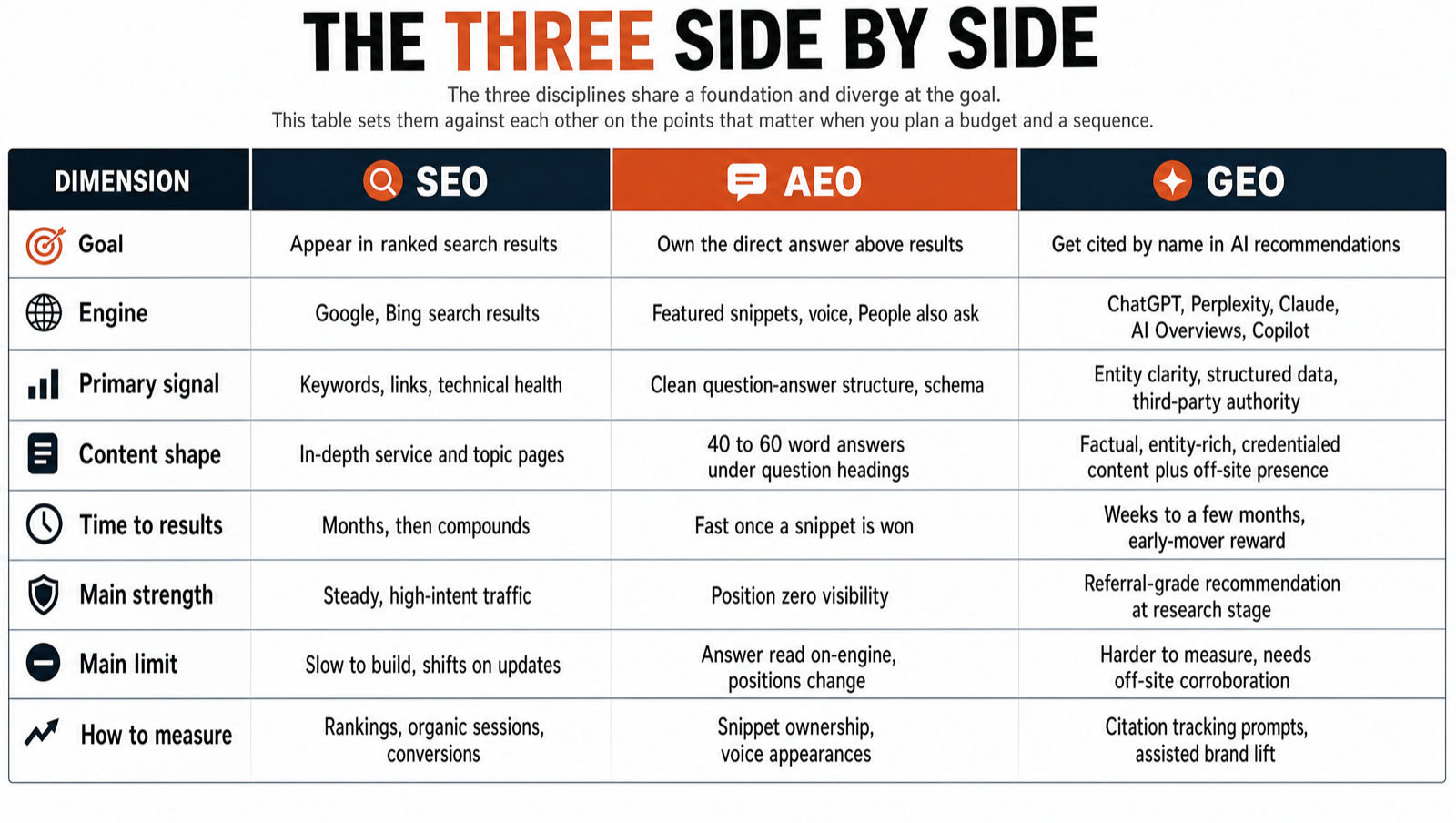
SEO and AEO share most of their machinery, so the same page can win both with structure added. GEO extends the work past your own site into structured data and independent authority. The overlap is why one build can feed all three.
Two Plays: The Company and the Executive
Maritime visibility splits into two assets that need different handling. Most firms invest in the first and leave the second idle.
The company play
Optimises the firm: service pages, Organization and Service schema, association links, and coverage of the company name. Answers queries like “ship management company Singapore” or “which firms manage LNG carriers in Southeast Asia.”
The executive play
Optimises a named person: the CEO, marketing director, or technical manager. Person schema, a credentialed bio, authored articles, and consistent professional profiles. Answers queries like “leading marine surveyor Rotterdam” or a buyer naming an executive to check their standing.
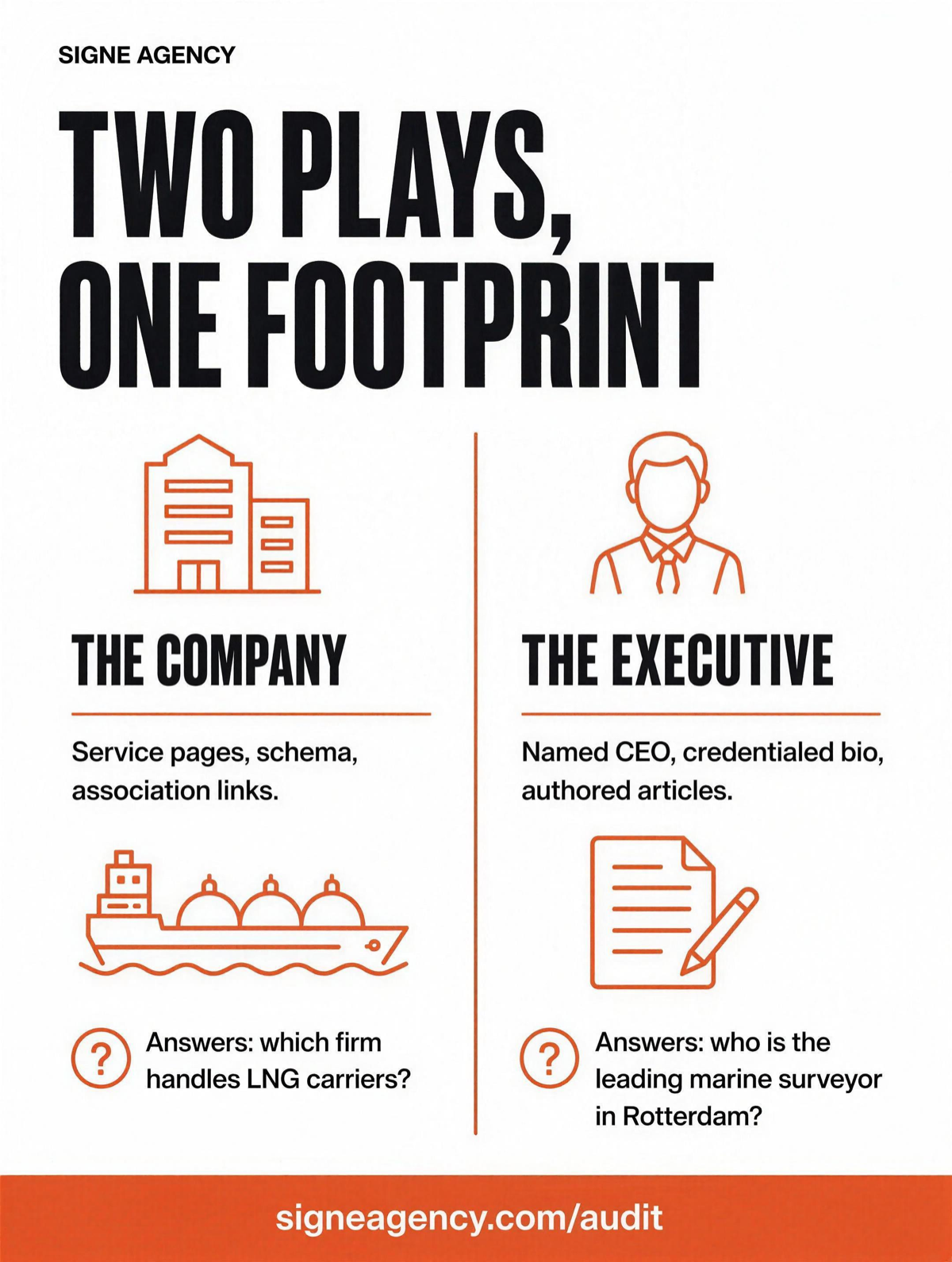
The executive play is the underused one. When a buyer or a journalist asks an AI tool about a person, the model assembles an answer from LinkedIn, authored content, interviews, and directory listings. A maritime executive with a clear, consistent, credentialed footprint becomes a citable authority. A maritime executive with a sparse footprint returns a thin answer. The signals are the same as the company play, pointed at a person.
An executive brand and a company brand reinforce each other. The CEO’s authored thought leadership earns the third-party authority that lifts the firm’s GEO presence, and the firm’s credibility supports the executive’s. Built together, each raises the other.
One Strategy Across All Three
The three disciplines run on one foundation. Building them in sequence turns a single content and data effort into visibility on every engine.
- Fix the entity first. Make the firm name, disciplines, locations, and registrations identical across the website, LinkedIn, and every directory. This single step serves SEO (trust and relevance), AEO (clean facts), and GEO (a confident identity).
- Add structured data once. Organization, Person, Service, and FAQPage schema feed all three engines from the same markup.
- Write answer-first content. Lead each section with the useful claim under a clear heading. The same page then ranks (SEO), wins snippets (AEO), and gives models a clean passage to cite (GEO).
- Build depth for SEO. Turn priority answers into full service and topic pages with real expertise and internal links.
- Earn third-party authority for GEO. Pursue mentions in trade publications, association directories, and reputable maritime media, for both the firm and its executives.
- Maintain the loop. Refresh cornerstone pages quarterly, update answers when regulation changes, and keep profiles consistent as the firm grows.
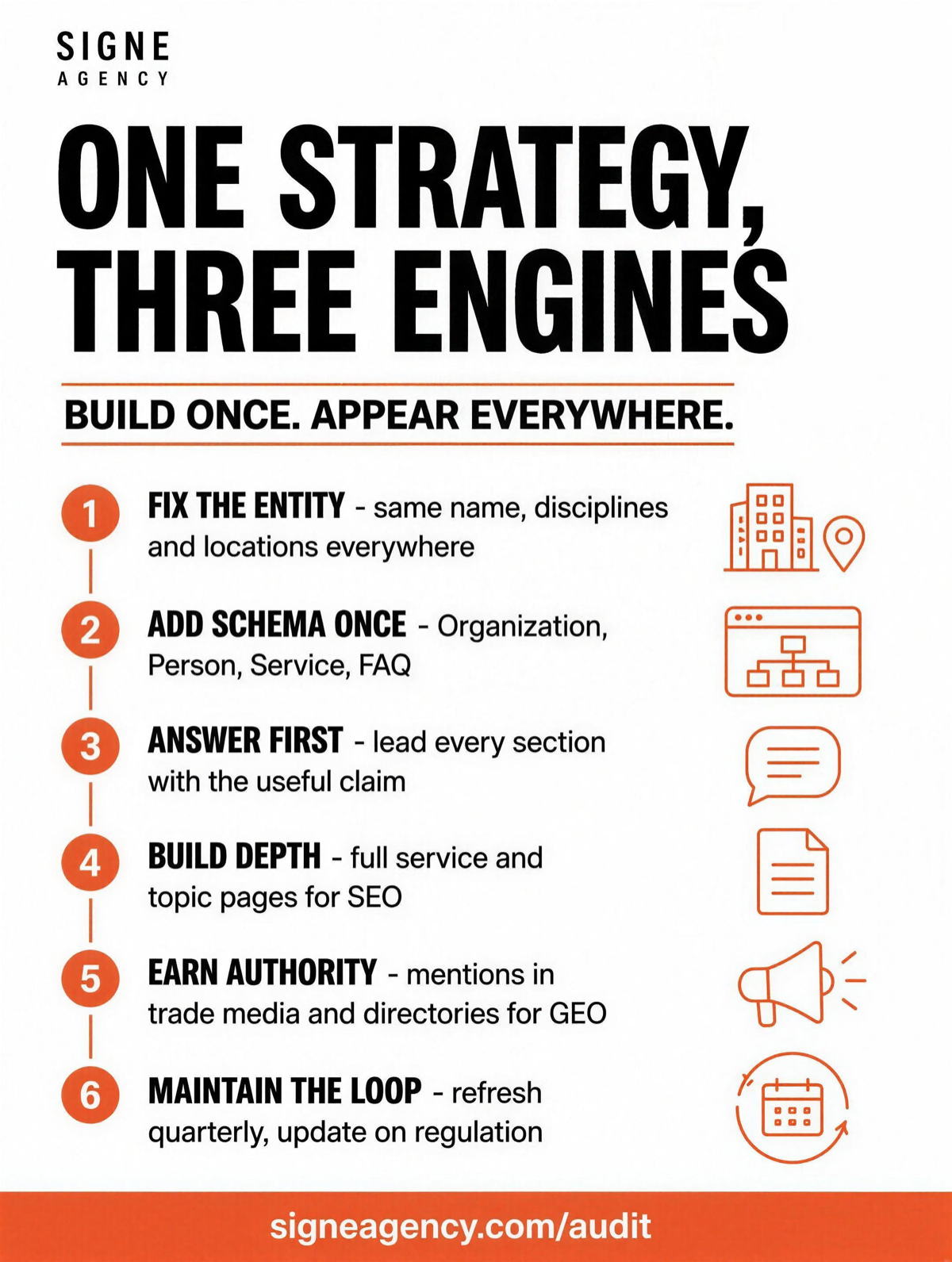
The future of search is multi-engine. One clean foundation of entities, schema, and answer-first content, extended with off-site authority, makes a maritime brand visible everywhere a buyer looks. Build once, appear across all three.
How to Measure Each Engine
Each discipline reports on a different surface, so the scorecard uses three lenses rather than one number.
- SEO. Track keyword rankings for priority service terms, organic sessions to service pages, and the enquiries those pages generate. These figures move steadily and reward a quarterly review.
- AEO. Track which questions your pages own as featured snippets and People also ask entries, and watch voice appearances for definitional queries. Snippet ownership is the headline metric.
- GEO. Run a fixed set of buyer-style prompts across ChatGPT, Perplexity, Claude, and Google AI Overviews on a schedule, and record whether your firm or executive is named and how accurately. Pair this citation tracking with assisted signals: direct traffic lift, branded search growth, and enquiries that mention an AI tool.
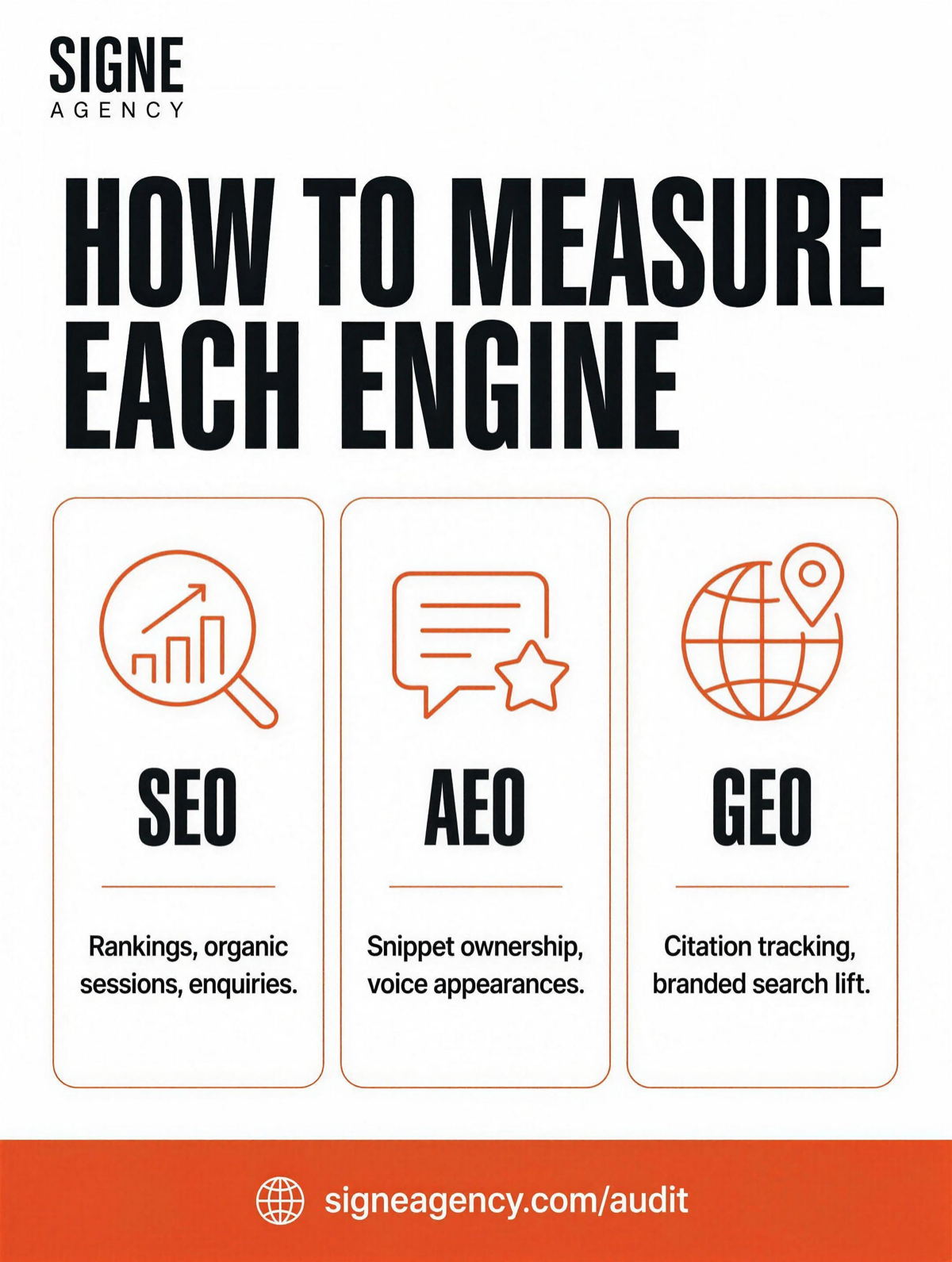
GEO rarely passes a clean referral link, so judge it by presence and accuracy in AI answers over a 60 to 90 day window rather than by a single click metric. Track the trend, and read it alongside branded search and direct traffic.
Common Mistakes That Keep Maritime Firms Invisible
Avoid these
Where to Start
The fastest way to see where you stand is a scan. Our free maritime AI visibility audit checks your site across the signals that drive SEO, AEO, and GEO, and returns a score with the priority fixes. Start there, then build the one foundation that makes you visible across every engine.
