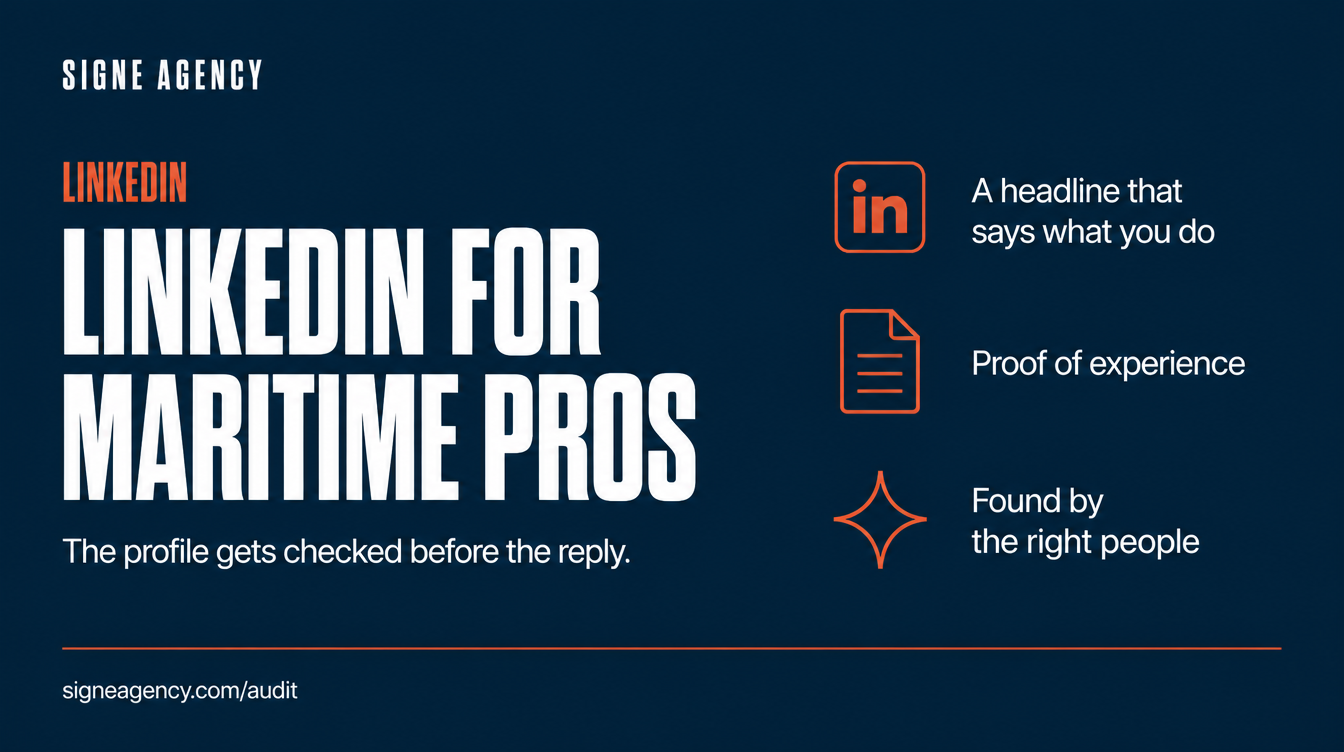
A hiring manager, a P&I club contact, a shipowner considering a surveyor, checks LinkedIn before replying to an email. This happens more often than most maritime professionals assume, and the profile they find usually says almost nothing. A job title, a company name, a photo. No indication of what this person actually does well, or for whom.
That gap costs opportunities quietly. Nobody tells you they did not reply because your profile gave them nothing to go on.
Your Headline Is Not Your Job Title
LinkedIn shows your headline everywhere: search results, comments, connection requests, messages. Most maritime professionals leave it as their job title and company name. That wastes the single most visible line available to explain what makes you worth a reply.
A stronger headline names the specific work, the specific scope, and one credential or number that makes it concrete. Not marine surveyor. Something closer to: senior marine surveyor, pre-purchase and condition surveys, fifteen years offshore experience. The difference is not tone. It is information density.
James Stavros
Senior Marine Surveyor | Pre-purchase, Condition & P&I Surveys | 15 Years Offshore Experience
Keywords + specific value: searchable and clear
Marine Surveyor at GlobalMarine Ltd
Just a job title: no value, no keywords
The About Section Nobody Reads Versus the One They Finish
Most About sections open with a sentence like: I am an experienced maritime professional with a passion for excellence. That sentence tells the reader nothing and gives them no reason to keep reading.
A stronger opening states plainly what you do, for whom, and where, in the first sentence, then backs it with a specific number: years of experience, surveys completed, vessels handled, ports covered. The reader finishes the paragraph because every sentence adds a fact, not an adjective.
Generic: skipped
I am an experienced maritime professional with a passion for excellence in the marine industry. I have worked in various roles across different vessel types and ports worldwide.
Specific: read in full
I survey bulk carriers and tankers on behalf of P&I clubs and owners across the Black Sea, Mediterranean, and Arabian Gulf. In 12 years of full-time surveying I have completed over 400 pre-purchase, condition, and damage surveys. If you need an independent assessment before a transaction or a claim. This is what I do.
Experience Section: Not a Crew Record
The Experience section should not look like a crew record. A crew record lists dates and vessel names. Your Experience section should tell the reader what you actually did and what resulted from it.
For each role: the company and vessel type, what you were responsible for in active statements, and at least one measurable result or notable outcome. Instead of Chief Officer on MV Atlantic Star, 2019–2022, write: Chief Officer, 75,000 DWT bulk carrier: oversaw cargo operations across 14 ports, led crew safety briefings for a 22-person team, reduced loading time variance by coordinating directly with terminal supervisors. You do not need a result for every bullet point, but one concrete detail per role changes a skimmable profile into an informative one.
Skills That Actually Matter in Maritime
The skills that matter for a maritime professional are the ones people search for. Specific, operational terms: vessel inspection, condition survey, P&I survey, ISM Code, SOLAS, MARPOL, cargo operations, bulk handling, planned maintenance systems by name. Endorsements carry less weight than your headline and About section in search ranking, but they add social proof. Ask two or three former colleagues directly. Most people will do it if asked specifically.
One Action to Take This Week
Open your LinkedIn profile and read your headline out loud. If it is just your job title, rewrite it using this structure: what you do, what you specialise in, who you do it for. Keep it to 220 characters. Publish the update. That single change makes your profile more findable. It takes ten minutes and it is the highest-return action on this list.
Your Personal Profile Outperforms Your Company Page
Most maritime companies invest time in their LinkedIn company page. Fewer invest time in the personal profiles of the people who run the company or lead client relationships. This is the wrong priority.
Company pages reach followers who have already chosen to follow them. Personal profiles reach anyone whose search results or feed surfaces a post, a comment, or a connection request. In maritime, where trust in a specific person often precedes trust in a company, the personal profile is the more valuable asset.
A maritime founder or commercial lead with a strong personal profile, one that clearly states what they do, who they serve, and what they know, will generate more inbound interest than a company page with twice the followers. The company page supports credibility. The personal profile generates contact.
What to Post and How Often
The question maritime professionals ask most often about LinkedIn is what to post. The answer is simpler than most content advice suggests: post what you know that your buyers do not.
A marine surveyor who posts about common inspection findings on bulk carriers in certain trade lanes is giving buyers a reason to follow them and a demonstration of expertise before any commercial conversation begins. A maritime lawyer who posts about how a recent P&I ruling affects charter party clauses is doing the same. The post does not need to be long. It needs to be specific enough that only someone with genuine experience in that area could have written it.
On frequency: consistency matters more than volume. Two posts per week, maintained over six months, will build more visible authority than ten posts in a burst followed by silence. The algorithm rewards consistency. So do buyers, who notice when a professional disappears after a period of activity.
What does not work: sharing industry news without commentary, reposting articles from shipping publications, generic posts about the importance of safety or sustainability. These exist in every maritime professional’s feed already. They add no signal about the person posting them.
Connecting With the Right People
Connection strategy on LinkedIn is not about volume. A maritime professional with 400 well-chosen connections in their specific sector will outperform one with 4,000 connections spread across every industry.
The right connections for most maritime professionals fall into three groups. First, the people who make or influence the buying decisions for your service: fleet managers, technical superintendents, commercial directors, port captains, P&I correspondents, depending on your sector. Second, peers and colleagues at a similar level who refer work and share intelligence. Third, journalists, association leads, and event organisers who amplify credibility.
When sending a connection request, include a short note that says specifically why you are connecting and what the connection offers them. Maritime professionals receive a significant number of generic connection requests. A specific, professional note converts at a far higher rate.
