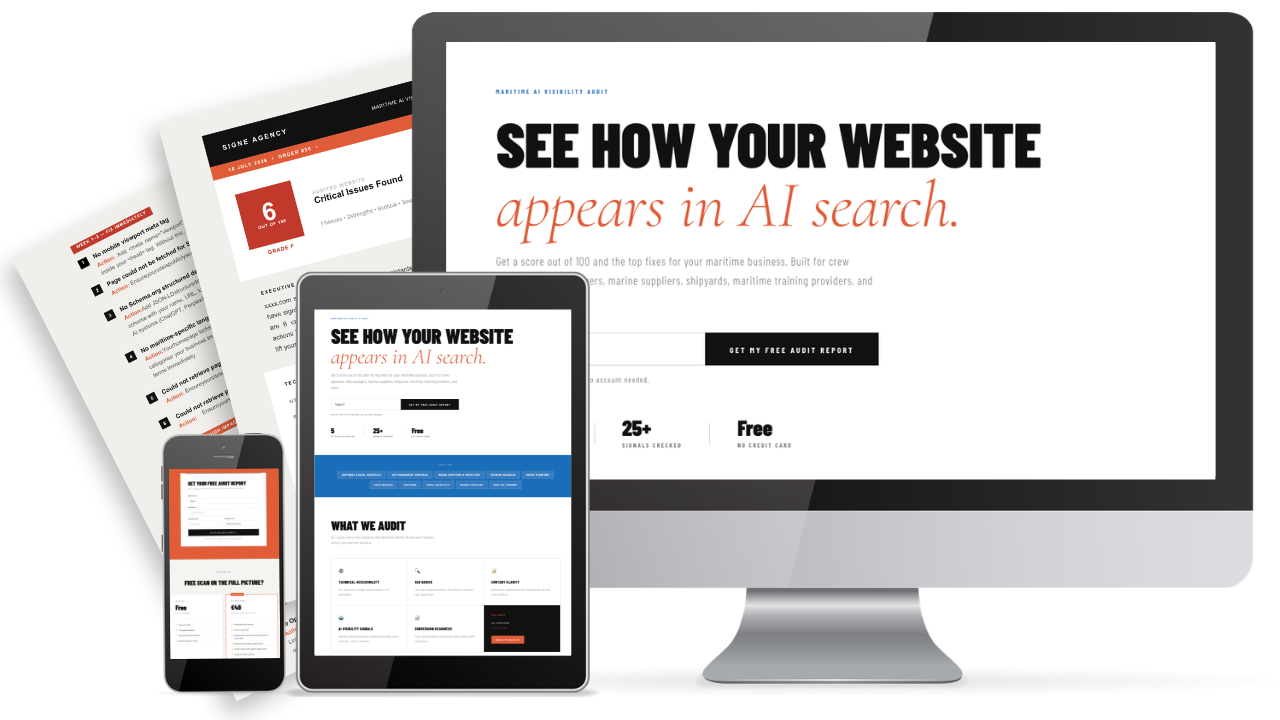
Last week we ran our Maritime AI Visibility Audit on two maritime websites on the same day.
The first is a specialist maritime professional based in Northern Europe. Small operation, strong reputation, well-maintained website. They scored 91 out of 100 and received a Grade A.
The second is a major international shipping company. Global fleet, significant revenue, a website that has clearly had professional investment. They scored 6 out of 100 and received a Grade F.
The gap between those two scores is not a fluke. It reflects a structural difference in how each website communicates with AI systems – and it has almost nothing to do with company size, budget, or reputation.
This post walks through both audits in detail: what the tool checked, what each score reveals, and what the difference actually means in practice for how maritime buyers find and evaluate suppliers through AI search.
What the Audit Checks
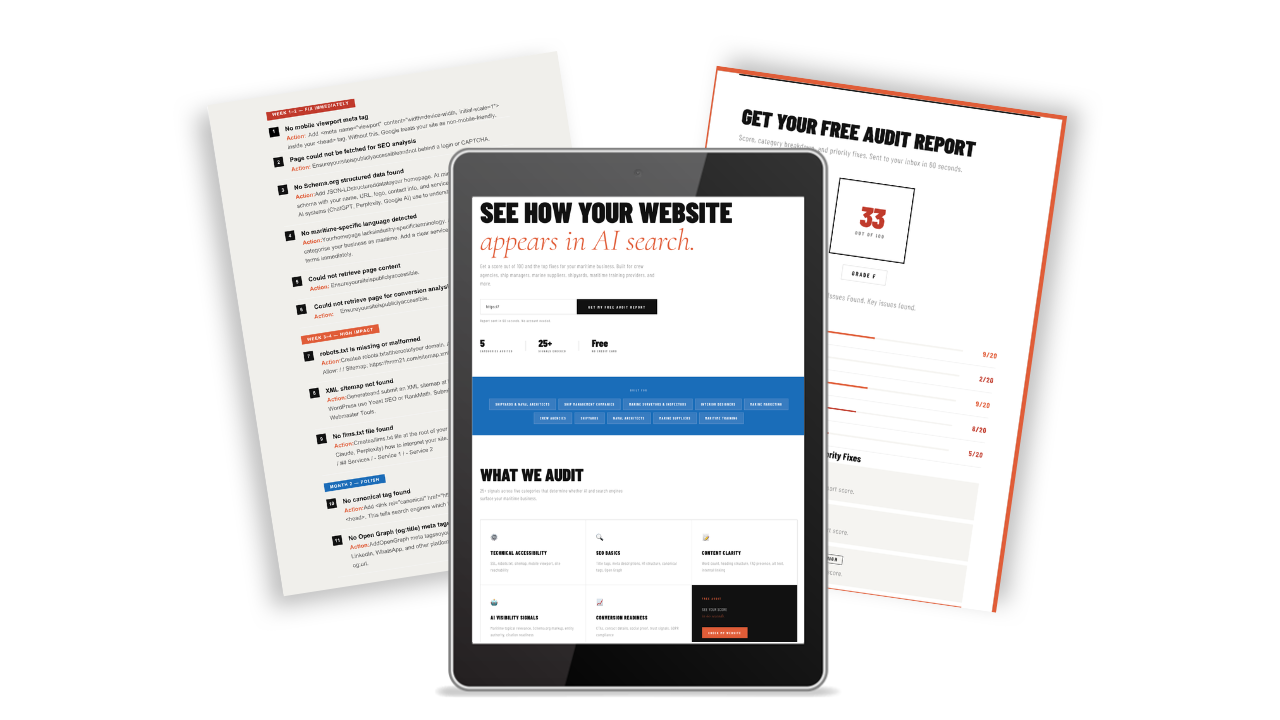
The Maritime AI Visibility Audit scores a website across five categories, each worth 20 points, for a maximum of 100.
Technical Readiness – whether the fundamental infrastructure is in place: HTTPS/SSL, robots.txt, XML sitemap, mobile viewport, canonical tags. These are the conditions that determine whether AI crawlers can reach the site at all.
SEO Readiness – whether the page is structured for both search engines and AI systems: page title length and keyword inclusion, meta description, H1 heading, content volume on the homepage.
AI/GEO Readiness – whether the site has the signals that specifically improve AI citation: Schema.org structured data, Open Graph tags, llms.txt, maritime-specific language that allows AI systems to categorise the business correctly.
Content Clarity – whether the homepage communicates clearly enough for AI to understand and represent the business: FAQ content, contact information, call-to-action presence, trust signals such as testimonials or credentials.
Conversion Readiness – whether the site gives a visitor the information needed to take action: content depth, social proof, clear service descriptions.
Each category produces a score out of 20. Seventy percent or above in any category is considered strong. Below fifty percent indicates significant gaps.
Audit One: The Specialist – 91/100, Grade A
The first company audited is a maritime specialist with a focused service offering, a clear target client, and a website that communicates what they do with precision.
Their technical snapshot came back almost entirely clean. HTTPS active. robots.txt present and valid. XML sitemap found. Mobile viewport set. Canonical tag present. Meta description within the correct length range. Single H1 heading. Homepage content volume of 3,490 words – well above the threshold for content depth.
Their Schema.org implementation was strong: Organisation, Person, PostalAddress, GeoCoordinates, FAQPage, Question, Answer, and several credential-related types. This is the structured data layer that AI systems rely on most heavily to understand a business – and most maritime websites have none of it.
Their score by category:
- Technical Readiness: 20/20
- SEO Readiness: 17/20
- AI/GEO Readiness: 14/20
- Content Clarity: 20/20
- Conversion Readiness: 20/20
Total: 91/100. Grade A.
The two remaining issues were both in SEO and AI/GEO Readiness: a page title slightly over the recommended 60-character limit, and no llms.txt file at the website root. Both are fixable in under an hour.
This is a well-built website doing almost everything correctly. The company did not achieve this score by spending heavily on digital marketing. They achieved it by building a site that is specific, technically clean, and rich with the structured signals that AI systems use to understand and cite businesses.
Audit Two: The Major Shipping Company – 6/100, Grade F
The second company is a well-known name in global shipping. Their fleet is large. Their revenue is significant. Their website has had professional investment. They scored 6 out of 100.
Their technical snapshot showed the scale of the problem immediately. No robots.txt. No XML sitemap. No Schema.org structured data of any kind. No Open Graph tags. No page title found. No meta description. No H1 heading. Zero words indexed on the homepage.
That last point is important. The audit tool could not retrieve page content from the homepage. This most likely means the site is built primarily in JavaScript, with content rendered client-side in a way that many crawlers – including AI crawlers – cannot read. The site may look polished to a human visitor. To an AI system, it is largely invisible.
Their score by category:
- Technical Readiness: 4/20
- SEO Readiness: 0/20
- AI/GEO Readiness: 2/20
- Content Clarity: 0/20
- Conversion Readiness: 0/20
Total: 6/100. Grade F.
The two things working in their favour: HTTPS/SSL is active, and there are no AI bot restrictions in robots.txt – meaning AI crawlers are not blocked, they simply have nothing to read when they arrive.
Their 30-day action roadmap contained 11 issues: 6 critical, 3 medium, 2 low. The critical issues are not niche technical problems. They are foundational: make the site crawlable, add a page title, write an H1 heading, add Schema.org structured data, include maritime-specific language so AI systems can categorise the business at all.
Company A – Specialist 91/100
- HTTPS/SSL Active
- robots.txt Present
- XML Sitemap Found
- llms.txt Missing
- Schema.org 9 types
- Open Graph Tags
- Page Title
- Homepage 3490 words
Company B – Major Shipping Co. 6/100
- HTTPS/SSL Active
- robots.txt Missing
- XML Sitemap Not found
- llms.txt Missing
- Schema.org None detected
- Open Graph Tags Missing
- Page Title Not found
- Homepage 0 words
What the Gap Actually Reveals
The 85-point difference between these two websites is not primarily a reflection of how much each company has invested in its digital presence. It is a reflection of the decisions made when each site was built.
The major shipping company almost certainly spent more on their website. The JavaScript-heavy, visually rich build they have chosen is a common choice for companies wanting a modern, dynamic digital presence. The problem is that it optimises for the experience of a human visitor arriving directly at the site – and performs poorly for the automated systems that are increasingly the first point of contact between a maritime buyer and a supplier.
The specialist, by contrast, built a straightforward site with clean HTML, structured data, clear copy, and the technical fundamentals in place. It is not flashy. It is readable – by browsers, by search engines, and by the AI systems that are now the dominant discovery mechanism for professional services buyers.
The commercial implication is significant. When a maritime buyer asks ChatGPT, Perplexity, or Google AI a question that should surface the major shipping company, the AI system has very little to work with. It may find the company name through external sources. It will not be able to cite their services, their coverage, or their specific capabilities from their own website, because the website communicates almost none of that to the AI.
The specialist gives AI systems exactly what they need: structured data, clear service descriptions, FAQ content, geographic specificity, and credential signals. When a buyer asks a question that their services answer, the AI has what it needs to cite them accurately.
What Separates a High Score from a Low One
Based on the audits run so far, the biggest differentiators between high-scoring and low-scoring maritime websites are consistently the same.
Crawlability. A site that cannot be read by automated systems cannot be cited by them. JavaScript-heavy builds without server-side rendering are the most common cause of complete AI invisibility, regardless of how much the site cost to build.
Schema.org structured data. This is the single highest-impact technical addition for AI visibility. Without it, AI systems have to infer what a business does from general copy – and those inferences are frequently incomplete or wrong. A marine survey company, a ship management firm, and a crew agency can all have websites that look similar to an AI if none of them use structured data.
Homepage content depth. A homepage with fewer than 500 words gives AI systems very little to work with. The specialist in this audit had 3,490 words on their homepage. The major shipping company had zero words detectable by the audit tool. That is not a minor gap – it is the difference between a site that can be cited and a site that effectively does not exist for AI search purposes.
Maritime-specific language. AI systems categorise businesses by the terminology they use. A maritime company whose homepage reads in generic corporate language – without vessel types, trade lanes, certifications, or operational specifics – may not be recognised as a maritime company at all. The specialist in this audit had strong maritime topical authority. The major shipping company registered none.
llms.txt. Still missing from the vast majority of maritime websites, including the 91-scorer audited here. It is the easiest single addition for any maritime site in 2026 – a plain text file that takes under an hour to write and publish, and tells AI systems directly what a site is about and which pages matter most.
The pattern that emerges across audits is consistent: the sites that score well are not the largest or best-funded – they are the most readable. Readable by humans, by search engines, and by the AI systems that are now doing the first round of supplier research for a growing proportion of maritime buyers.
A well-known company name built on decades of offline reputation does not transfer automatically to AI visibility. That reputation has to be re-expressed in the language AI systems can read: structured data, clean HTML, specific content, and the technical foundations that allow crawlers to reach the site in the first place.
